Digital forensic examiners are exceptionally good at compartmentalization.
Sometimes we have to be.
An examiner can spend the morning reconstructing the final hours before a homicide, the afternoon reviewing child sexual abuse material, and the following day sitting in a courtroom explaining timestamps, artifacts, and metadata as though everything examined was simply another collection of files.
Technically, that is the job.
Psychologically, it is not that simple.
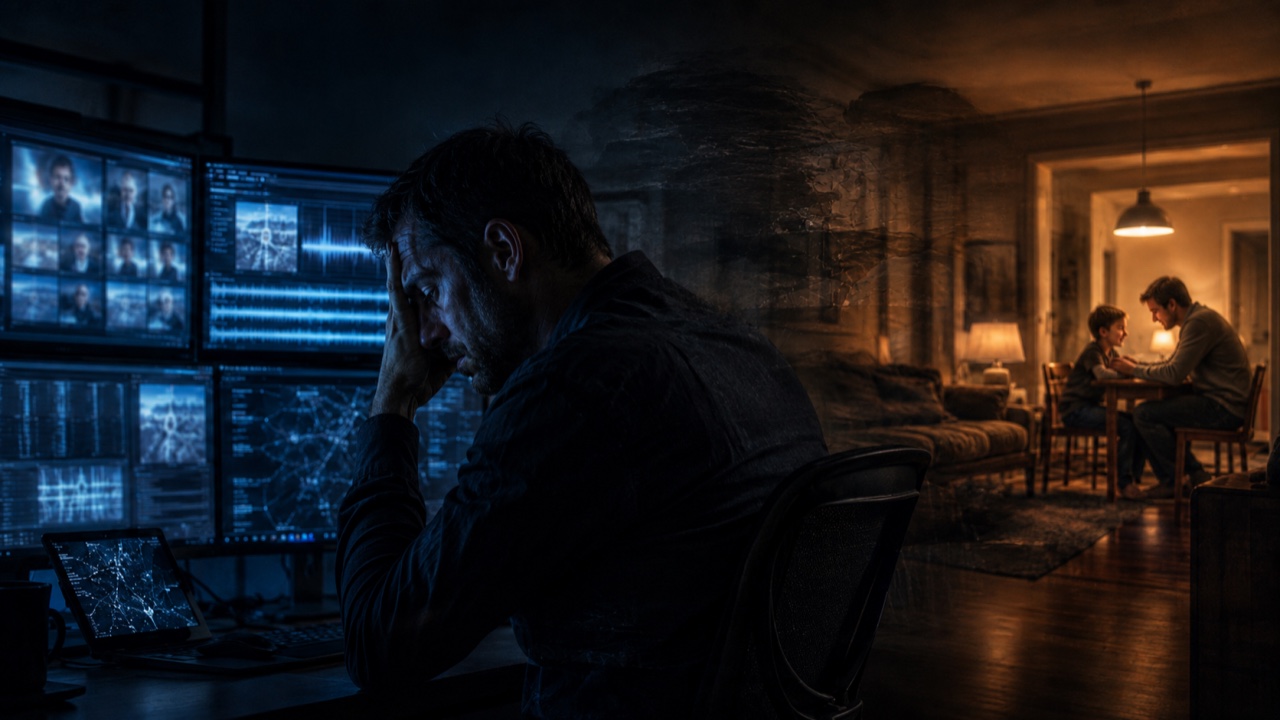
The monitor creates physical distance from the crime scene. It does not necessarily create psychological distance from the crime.
In some respects, digital forensics creates a particularly unusual form of exposure.
A first responder may encounter a horrific scene once.
The examiner may encounter that same event dozens or hundreds of times.
We replay the video. We enlarge individual frames. We listen to the audio again. We classify images. We bookmark evidence. We reconstruct conversations. We read the victim's final messages. We determine what happened before, during, and after the event.
Then we document it.
Months later, we may open everything again while preparing for court.
And then we may display it to a jury.
That repeated exposure is something our profession needs to discuss more openly.
Not because digital forensic examiners are fragile.
Because they are human.
And human performance is part of forensic quality.
This Is an Occupational Risk, Not a Character Flaw
The U.S. Department of Justice's Office for Victims of Crime describes vicarious trauma as an occupational challenge associated with continuous exposure to victims of trauma and violence.
Its examples specifically include looking at videos of exploited children, reviewing case files, and repeatedly encountering the aftermath of violence.
The National Institute of Justice has also begun drawing greater attention to the health and wellness of forensic science professionals.
NIJ notes that forensic professionals encounter unique occupational stressors capable of producing vicarious trauma, yet forensic personnel have often been overlooked when agencies develop health and wellness resources.
That should concern every laboratory director and supervisor.
We have spent decades building controls around evidence:
- Write blockers
- Hash verification
- Chain of custody
- Validation
- Peer review
- Technical review
- Accreditation
- Standard operating procedures
- Competency testing
Yet the individual ultimately interpreting that evidence can work under chronic stress, sleep deprivation, traumatic exposure, enormous caseloads, and relentless deadlines.
That is a human-factors problem.
And human factors belong inside quality assurance.
First, Understand What We Are Talking About
Several concepts get grouped together when discussing examiner wellness. They overlap, but they are not identical.
Burnout
Burnout generally develops from prolonged occupational stress.
For a digital forensic examiner, the source may have little to do with disturbing imagery.
It may be:
- A 14-month backlog
- Constant priority cases
- Unrealistic turnaround expectations
- Working nights after already working all day
- Being the only qualified mobile examiner in the unit
- Never-ending training requirements
- Court deadlines
- Prosecutor demands
- Management pressure
- Being expected to know every application, operating system, encryption scheme, cloud platform, artifact, and forensic tool
- Knowing that one overlooked artifact could affect someone's freedom
A 2024 NIJ-sponsored study evaluating burnout among 500 investigators and forensic examiners exposed to child sexual abuse material found 20 percent of participants exhibited high burnout. The researchers developed a short self-assessment approach intended to help identify individuals at increased risk earlier.
Burnout is not simply being tired after a difficult week.
It can change the way someone approaches the work.
Vicarious Trauma
Vicarious trauma involves changes that can result from repeated exposure to the trauma experienced by other people.
For DFIR personnel, that exposure can occur through images, videos, audio, messages, case narratives, victim communications, autopsy material, homicide evidence, terrorist propaganda, suicide evidence, sexual violence, and child exploitation material.
The Office for Victims of Crime identifies possible reactions including emotional numbing, sleep problems, distraction, relationship difficulties, irritability, withdrawal, destructive coping behavior, avoidance, and changes in a person's view of the world.
That last one deserves attention.
Sometimes the effect is not nightmares.
Sometimes the effect is believing that everyone is dangerous. That every parent is capable of something terrible. That every online conversation involving a child looks suspicious. That people cannot be trusted. That the world is fundamentally worse than you believed it was before you started doing this work.
An examiner can still perform exceptionally well while those changes are occurring.
That is partly why they can be difficult to recognize.
Digital Forensics Has a Unique Exposure Problem
People sometimes assume investigators are at greater psychological risk because they interact directly with victims, offenders, and crime scenes.
The research suggests the situation is more complicated.
A 2024 study involving 470 U.S. police investigators and forensic examiners exposed to child sexual abuse material found differences between investigators and forensic examiners in how exposure factors related to mental-health variables. The researchers concluded that the two populations can face distinct challenges requiring tailored support mechanisms.
That makes sense operationally.
The investigator and examiner may experience completely different versions of the same case.
The investigator may conduct interviews, make arrests, speak with victims, and coordinate prosecution.
The forensic examiner may sit alone wearing headphones examining 400 videos.
One person's exposure is interpersonal. The other's may be repetitive, highly concentrated, visually explicit, and isolated.
Neither should automatically be considered more difficult.
They are different occupational environments.
Our wellness programs should recognize that.
One of the Most Important Research Findings Is Also One of the Most Useful
Here is where this becomes especially important for supervisors.
Research involving investigators and forensic examiners who regularly review child sexual abuse material found something that may surprise people.
The amount, frequency, and duration of exposure were not consistently associated with poorer mental health in that study, with one significant exception: exposure to violent CSAM was associated with elevated post-traumatic stress symptoms.
What did matter?
A number of organizational and operational variables.
Better wellbeing was associated with factors including:
- Greater control over assigned work
- Knowing how cases ultimately ended
- Officer wellness programs
- Organizational respect for the work
- Adequate vacation and personal leave
- Opportunities to talk with others about difficult material
- Taking breaks
- Supportive organizational practices
That is extremely important.
Because those are variables leadership can influence.
The lesson is not: "Exposure does not matter."
The lesson is: exposure alone does not determine outcome. The environment surrounding the examiner matters considerably.
That moves examiner mental health from being solely an individual responsibility into the realm of leadership.
For the Examiner: Learn Your Own Baseline
One of the mistakes experienced professionals can make is assuming that if the work has never affected them before, it never will.
That is not a reliable assumption.
People change. Cases change. Life circumstances change. Sleep changes. Relationships change. Workloads change.
And sometimes one particular case gets through defenses that hundreds of previous cases did not.
That does not mean anything is wrong with the examiner.
It means the examiner should know his or her baseline well enough to recognize a significant change.
Watch for changes in four areas.
1. Sleep
Pay attention if you begin:
- Replaying material while trying to sleep
- Waking frequently
- Delaying sleep intentionally
- Feeling exhausted despite adequate time in bed
- Using alcohol or other substances specifically to shut your mind off
Sleep problems are among the potential reactions identified in DOJ vicarious-trauma guidance.
2. Behavior
Look for changes such as:
- Avoiding certain cases
- Becoming unusually impatient
- Withdrawing from colleagues
- Working constantly instead of disengaging
- Losing interest in things you normally enjoy
- Increasing alcohol consumption
- Becoming more aggressive or confrontational
- Isolating yourself at home
These do not establish a diagnosis.
They are signals that something may have changed.
3. Thinking
This area matters greatly to forensic professionals.
Watch for:
- Difficulty concentrating
- Re-reading the same material repeatedly
- Forgetfulness
- Losing your place during examinations
- Increasing difficulty writing reports
- Reduced patience for verification
- Making simple mistakes you normally would not make
- Becoming mentally exhausted unusually early
Stress should concern forensic laboratories not only because of employee wellbeing, but because forensic work depends heavily on human judgment. Research into forensic decision-making increasingly treats workplace stress as a human factor that can influence professional performance and decision processes.
This is where mental health becomes a quality-control issue.
4. Worldview
This one can be subtle.
Ask yourself whether the work has materially changed how you perceive people outside of work.
Are you substantially more suspicious? More cynical? More fearful for your children? Less trusting of other adults? Emotionally detached? Unable to stop mentally evaluating normal situations through the lens of your cases?
The Office for Victims of Crime specifically identifies changes in worldview as a potential consequence of prolonged occupational trauma exposure.
For people who spend years looking at the worst things humans do, that deserves serious consideration.
The Examiner's Exposure-Control Protocol
There are practical things examiners can do during difficult examinations.
These are not substitutes for professional mental-health care when that is needed.
Think of them as exposure controls.
1. Stop consuming evidence that has no forensic purpose.
This may be the most important operational principle.
Your job is to examine evidence.
Your job is not to absorb suffering unnecessarily.
If you have established the evidentiary fact required for the examination, ask whether continued exposure is necessary.
Do not confuse endurance with professionalism.
2. Let technology reduce unnecessary exposure.
Where legally, procedurally, and forensically appropriate, use technology to minimize redundant human review.
That can include known-file hashing, deduplication, automated categorization, targeted searches, metadata filtering, timeline filtering, representative previews, existing intelligence databases, and automated triage.
Automation does not eliminate the examiner.
It can eliminate unnecessary exposure before the examiner has to make a judgment.
That is a meaningful distinction.
3. Control audio when audio is not evidentially necessary.
Audio can substantially change the emotional intensity of video evidence.
Research involving CSAM investigators identified turning audio down or off, avoiding unnecessarily prolonged viewing, taking breaks, focusing on the task, and talking to others as strategies associated with wellbeing.
If the audio does not need to be heard at that moment, consider whether it needs to be playing.
When it does need forensic examination, examine it deliberately.
4. Work with a forensic question.
Instead of: "I need to watch 600 videos."
Frame the task as: "I need to determine whether this device contains material meeting these evidentiary criteria and document the relevant artifacts."
That distinction sounds small. It is not.
Task orientation helps keep attention on the forensic purpose rather than the emotional content.
The examiner is looking for evidence, not consuming media.
5. Take deliberate breaks.
Not scrolling on your phone while sitting at the forensic workstation.
Leave the room. Move. Get water. Go outside if practical. Allow your attention to disengage.
Research involving CSAM investigators found taking breaks among the strategies associated with better outcomes.
6. Talk to someone who understands the work.
There are obvious confidentiality limitations surrounding forensic cases.
Respect them.
But isolation should not be the default coping mechanism.
Talking with other professionals involved in the work was associated with better wellbeing in CSAM research, and OVC guidance emphasizes supportive processes for discussing traumatic occupational content.
Sometimes the most useful conversation is simply: "That case was rough."
The other examiner already understands what that means.
7. Create a boundary between the lab and home.
The evidence cannot always stay at work mentally.
But you can create a transition.
It might be the drive home, exercise, changing clothes, walking, music, dinner with family, or a specific end-of-work routine.
The point is not the activity.
The point is giving your brain a consistent marker: the examination is finished for today.
OVC specifically recommends establishing work-to-home transitions as one method for creating boundaries around occupational trauma exposure.
There Is One Coping Strategy Worth Calling Out Specifically
Alcohol.
The reason is not moral judgment.
It is because the research is worth knowing.
In the study of investigators and forensic examiners exposed to CSAM, drinking alcohol after work as a coping strategy was associated with poorer wellbeing and greater mental-health symptoms.
There is an important difference between: "I had a beer with dinner."
and: "I need a few drinks because of what I saw today."
An examiner should recognize that distinction early.
So should a supervisor.
Supervisors: This Part Is Yours
There is a bad model of supervision that still exists in high-stress professions:
"My door is always open."
That sounds supportive.
But it transfers almost all responsibility to the employee.
The examiner experiencing the problem must:
- Recognize it.
- Admit it.
- Decide it is serious enough.
- Overcome whatever stigma exists.
- Approach the person who influences assignments, promotions, evaluations, and opportunities.
- Explain that they are struggling.
Then we wonder why people remain silent.
An open door is useful.
It is not a wellness program.
Supervisors Need to Know Their People Before There Is a Problem
If you supervise forensic examiners, you should know their normal professional baseline.
Not their private lives.
Their professional baseline.
Who is normally talkative? Who works quietly? Who writes extremely quickly? Who normally has excellent attention to detail? Who becomes visibly frustrated under backlog pressure? Who has been working exploitation cases continuously? Who has recently handled a particularly violent case? Who has been testifying repeatedly? Who has accumulated excessive overtime? Who has stopped taking leave?
You cannot recognize change if you do not know normal.
Stop Asking Only: "Are You Good?"
Most examiners will say yes.
Especially the experienced ones.
Try better questions.
- After a difficult examination: "That was a difficult case. How are you doing with the material?"
- During sustained exposure: "You've been on these cases continuously for several weeks. Do we need to change the workload?"
- When behavior changes: "I've noticed you've been quieter than usual and staying later. I'm not making assumptions, but I wanted to check on you."
- When offering resources: "Using support services will not change how I view your capability as an examiner."
The objective is not therapy.
Supervisors should not attempt to diagnose employees.
The objective is creating an environment in which an examiner can identify a problem before the problem becomes a crisis.
Give Examiners Some Control
This is one of the most actionable findings from the research.
Greater control over work assignments was associated with better wellbeing among personnel examining CSAM.
That does not mean: "Nobody has to work a difficult case."
The mission still exists.
It means treating examiners like professionals rather than interchangeable processing units.
When possible:
- Rotate exceptionally difficult assignments.
- Let examiners flag when they need temporary task variation.
- Avoid giving one person the worst cases simply because that person is good at them.
- Balance high-exposure examinations with lower-exposure technical work.
- Avoid rewarding competence with endless trauma.
That last point happens more often than organizations admit.
The strongest examiner becomes the person who receives every difficult case.
That is not always recognition.
Sometimes it is organizational overexposure disguised as trust.
Tell Examiners What Happened to Their Cases
This is an extraordinarily simple intervention.
And supervisors should pay attention to it.
Knowing the final resolution of cases was associated with better wellbeing in research involving CSAM investigators and forensic examiners.
Think about the psychology of the examiner's role.
We may spend 40 hours analyzing a phone, 70 hours examining a computer, days identifying victims, nights reconstructing activity, and weeks documenting evidence.
Then the report leaves.
And we hear nothing.
Was the child rescued? Was the suspect convicted? Did the evidence matter? Was the victim identified? Was the person exonerated? Was the case dismissed?
Sometimes the examiner never knows.
When policy permits, close that loop.
Meaning matters.
Backlogs Are a Wellness Issue Too
Not every DFIR mental-health problem involves traumatic imagery.
Some involve Excel.
Specifically, the spreadsheet showing 417 devices waiting for examination.
Research in forensic science has repeatedly identified workload, management, supervision, backlogs, time pressure, and expectations surrounding performance as workplace stressors.
Supervisors need to recognize what chronic backlog pressure does.
When every case is urgent, nothing is urgent.
When an examiner finishes one device and three more arrive, there is no psychological sense of completion.
When employees repeatedly hear: "We just need everyone to push a little harder."
the extraordinary eventually becomes normal.
That is not sustainable capacity planning.
That is borrowing productivity from your future workforce.
A Backlog Should Never Become a Reason to Ignore Human Limits
If your laboratory has more work than its personnel can sustainably perform, the mathematical problem cannot be solved indefinitely through examiner sacrifice.
You need some combination of more personnel, better triage, narrower examination requests, better investigative prioritization, more automation, improved tooling, additional training, outsourcing where appropriate, reduced duplication, stronger submission criteria, better case management, and different expectations.
"Work harder" is not capacity planning.
Psychological Screening Should Become Normal in High-Exposure Units
This may be where the profession is heading.
In April 2026, His Majesty's Inspectorate of Constabulary and Fire & Rescue Services issued recommendations concerning online child sexual abuse investigations in England and Wales.
One recommendation is particularly noteworthy.
By October 31, 2026, forces were told to ensure that personnel and supervisors in relevant online child sexual abuse and sexual offender management teams receive mandatory psychological health screening at least annually, with access to follow-on wellbeing services.
The recommendation also calls for supervisors to receive regular trauma-informed training so they can recognize signs of trauma, burnout, and other wellbeing problems and refer personnel for timely support.
That is not a universal international standard.
But DFIR leaders should pay attention to the direction.
Annual psychological screening should not mean: "We think something is wrong with you."
It should mean: "You work in an occupational environment where psychological exposure is foreseeable, so monitoring it is part of workplace safety."
We routinely send employees for hearing tests, respirator fit testing, physical examinations, firearms qualification, occupational health checks, and safety training.
Normalizing psychological screening for sustained trauma-exposure roles follows the same basic occupational-health logic.
Confidentiality Is Critical
A wellness program that employees do not trust is nearly useless.
Examiners need to understand:
- What information remains confidential
- What information can reach management
- What mandatory reporting obligations exist
- Whether participation affects security clearances where applicable
- Whether treatment affects assignments
- Whether supervisors receive clinical details
- Whether utilization is documented in personnel files
Organizations should answer those questions before employees need the service.
Fear fills information vacuums.
If personnel believe asking for help could destroy their career, many will not ask.
Supervisors Need Training Too
Promoting the best examiner to supervisor does not automatically teach that person how to recognize occupational trauma.
Technical competency and people leadership are different skill sets.
Supervisors in high-exposure forensic units should receive training on vicarious trauma, burnout, secondary traumatic stress, behavioral warning signs, constructive conversations, referral pathways, confidentiality boundaries, workload management, exposure rotation, critical incidents, suicide awareness, substance misuse warning signs, and returning employees to difficult casework appropriately.
This is increasingly reflected in formal policing recommendations. The 2026 HMICFRS recommendation specifically calls for regular trauma-informed training and knowledge sharing for supervisors in high-exposure units.
What Supervisors Should Never Say
Some phrases shut conversations down immediately.
"Everyone here sees bad things."
True. Irrelevant. Everyone also responds differently.
"You knew what the job was."
Knowing traumatic evidence exists and knowing exactly how years of exposure will affect you are different things.
"Maybe this isn't the job for you."
That sentence can guarantee the next struggling examiner tells you nothing.
"Don't take the work home."
If psychological compartmentalization were that simple, occupational trauma would not be a research field.
"Let me know if it gets really bad."
The objective is to intervene before it becomes really bad.
The DFIR Wellness Standard I Would Implement
If I were building or advising a digital forensic laboratory today, I would implement a minimum framework like this.
1. Pre-exposure training
Before an examiner begins routine work involving highly disturbing material, explain the occupational risks and available resources.
Do this before the person needs them.
2. Baseline psychological assessment
For personnel entering sustained high-exposure assignments, establish access to a qualified mental-health professional familiar with trauma-exposed occupational populations.
3. Regular confidential screening
At minimum, consider annual screening for sustained high-exposure roles, with more frequent access when necessary.
The 2026 HMICFRS recommendation provides a significant contemporary benchmark for this approach.
4. Supervisor training
Anyone supervising high-exposure examiners should know how to recognize behavioral changes and how to initiate a conversation without attempting to become a therapist.
5. Exposure-aware workload management
Track more than case count.
One homicide video examination and one routine fraud-device examination are not psychologically equivalent simply because they both count as "one case."
6. Examiner control
Give personnel reasonable influence over workload rotation and temporary changes in assignment.
Research suggests perceived control over work assignments can matter.
7. Technical exposure reduction
Use defensible automation, hashing, filtering, categorization, and targeted analysis to reduce unnecessary human exposure while preserving forensic requirements.
8. Structured supervisor check-ins
Not therapy. Not interrogation. Professional conversations.
And not only after someone appears to be struggling.
9. Case-resolution feedback
Where legally and operationally appropriate, tell examiners what resulted from significant cases.
The work feels different when the examiner knows what it accomplished. Research supports an association between receiving case-resolution information and better wellbeing.
10. Protected leave
Personnel should be able to take legitimate leave without returning to an even more impossible workload.
Research involving CSAM personnel found ample vacation and personal time associated with better wellbeing.
11. Peer support
Build access to people who actually understand digital forensic work.
A clinician can understand trauma.
A trained peer can understand why someone spent six hours rebuilding a timeline from material they wish they had never seen.
The two resources can complement each other.
12. Measure the program
If your laboratory measures turnaround time, backlog, utilization, quality failures, training hours, overtime, and case completion, then consider measuring workforce indicators too.
Look at sick leave, overtime trends, turnover, leave utilization, vacancy rates, employee surveys, wellness-resource utilization at an aggregate level, burnout screening where professionally administered, and exit interviews.
What gets measured gets managed.
Mental Health Is a Forensic Quality Issue
This is where I want the profession to change its thinking.
Mental health should not sit exclusively inside an HR presentation once a year.
An exhausted examiner is still an examiner.
A burned-out examiner is still interpreting evidence.
A distracted examiner is still making decisions.
A severely stressed examiner is still determining which artifact matters and which does not.
Forensic scientists operate in environments where human judgment can affect investigations and legal outcomes, and research increasingly recognizes workplace stress as a relevant human factor in forensic decision-making.
That does not mean every stressed examiner makes mistakes.
It means laboratories should manage human performance with the same seriousness they apply to other variables capable of affecting quality.
There Is Also Another Side to This Work
We should not portray every digital forensic examiner as psychologically damaged.
The evidence does not support that conclusion.
Many investigators and forensic professionals exposed to disturbing material remain psychologically healthy and find significant meaning in their work.
OVC describes concepts such as vicarious resilience and compassion satisfaction, recognizing that trauma-exposed work can also produce meaning, purpose, appreciation, and professional fulfillment.
That matters.
Most of us did not enter digital forensics because we enjoy parsing SQLite databases.
We entered because the artifact means something.
A location proves where someone was. A deleted message changes the timeline. A photograph identifies a victim. A cloud record establishes intent. A recovered video clears an innocent person. A device leads investigators to a child who can still be rescued.
The work matters.
And that sense of mission can be protective.
But purpose should never become an excuse for neglecting the person doing the work.
When an Examiner Should Consider Getting Professional Help
This article is not a diagnostic tool.
But if changes in sleep, mood, concentration, relationships, alcohol or substance use, anxiety, intrusive memories, avoidance, emotional numbness, anger, or ability to function are becoming persistent or worsening, that is a reasonable point to talk confidentially with a qualified mental-health professional.
You do not need to wait until your performance collapses.
You do not need to wait until your family notices.
You do not need to wait until your supervisor orders you to do something.
Early intervention is generally easier than crisis intervention.
OVC specifically recommends professional or therapeutic assistance when occupational trauma reactions warrant it.
And Supervisors Need to Understand Something Important
Your best examiner may be the person least likely to tell you.
The person everyone relies on. The one who never complains. The examiner who can handle anything. The person who gets every horrible case because everyone knows they will get it done.
That is precisely why supervisors must look beyond performance.
High performance does not automatically equal high wellbeing.
Someone can still produce excellent work while paying an increasingly high personal price for producing it.
Eventually, the organization receives that bill.
It arrives as burnout, absenteeism, turnover, relationship problems, alcohol misuse, declining performance, loss of experienced personnel, medical leave, early retirement, or someone simply deciding they cannot do the work anymore.
Preventing that is not lowering standards.
It is protecting capability.
The Conversation DFIR Needs to Have
Digital forensic examiners deal with evidence most people will never see.
We examine what offenders tried to hide.
We recover things victims wished had never existed.
We reconstruct moments families would give anything to change.
And then we move to the next case.
That ability to continue is one of the strengths of this profession.
But strength should not require silence.
The profession has become extremely sophisticated about protecting digital evidence.
We understand contamination. We understand integrity. We understand validation. We understand repeatability. We understand documentation.
We understand that small procedural failures can eventually become large evidentiary problems.
We should apply the same reasoning to ourselves.
If an occupational hazard is foreseeable, we control it.
If exposure can be reduced, we reduce it.
If a process can be monitored, we monitor it.
If someone needs additional support, we provide it early.
And if leadership can change the environment, leadership has a responsibility to do so.
Because the examiner is not separate from the forensic process.
The examiner is one of its most important components.
Protecting the examiner protects experience. It protects judgment. It protects retention. It protects families. It protects laboratories.
And ultimately, it protects the integrity of the work itself.
The evidence may follow us home.
Our profession should make sure examiners do not have to carry it alone.
For DFIR Leaders
If you supervise examiners, do one thing after reading this:
Ask whether your organization has an actual system for managing occupational trauma, or merely resources people can find after something goes wrong.
Those are not the same thing.
For Examiners
Do one thing as well:
Know your baseline.
The objective is not to become unaffected by difficult work.
The objective is to recognize when the work is beginning to affect you differently.
That awareness is not weakness.
In a profession built around recognizing artifacts others miss, it may be one of the most important artifacts you ever identify.
Sources and further reading
- Office for Victims of Crime, U.S. Department of Justice. The Vicarious Trauma Toolkit: "What Is Vicarious Trauma?" ovc.ojp.gov/program/vtt/what-is-vicarious-trauma
- National Institute of Justice. "Safeguarding Forensic Science Professionals." nij.ojp.gov
- "A Self-Assessment Tool for Helping Identify Police Burnout Among Investigators of Child Sexual Abuse Material," AJPM Focus (2024), NIJ-sponsored. ajpmfocus.org
- Gewirtz-Meydan et al., "Trauma behind the keyboard: Exploring disparities in child sexual abuse materials exposure and mental health factors among investigators and forensic examiners, a network analysis," Child Abuse & Neglect, Vol. 152 (2024). sciencedirect.com
- "The mental health of officials who regularly examine child sexual abuse material: strategies for harm mitigation," BMC Psychiatry (2023). bmcpsychiatry.biomedcentral.com
- His Majesty's Inspectorate of Constabulary and Fire & Rescue Services. "The policing response to the investigation of online child sexual abuse and the management of registered sex offenders" (published April 15, 2026), Recommendation 15. hmicfrs.justiceinspectorates.gov.uk
- Jeanguenat, A.M., and Dror, I.E., "Human Factors Effecting Forensic Decision Making: Workplace Stress and Well-being," Journal of Forensic Sciences, Vol. 63, No. 1 (2018). onlinelibrary.wiley.com